Interview and Q&A Sitting Next to a Stranger book launch
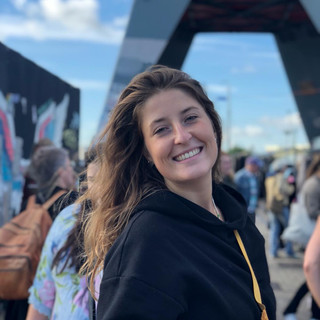
Eline Vedder is a Dutch fiction writer living in Prague, Czech Republic. Her debut novel Sitting Next to a Stranger is written for readers yearning to break out of their self-imposed boxes. Andrew Van Wilpe is an EU-based American actor and writer, best known for Interview with the Vampire. He brings his passion for storytelling to both stage and screen.
Eline and Andrew are friends. They like to celebrate their creative endeavors. So that’s what they did on April 26th, in a small garden in Prague. Eline, Andrew, and 25 guests were all there to celebrate the launch of Eline’s book Sitting Next to a Stranger.
Read the full interview below the video, or click Play to see the recording on YouTube.
Eline: I'm so happy to be here. I was nervous the whole day. We all started as strangers. There are strangers in the back there. I met some of you today. It took me three years to write this book. It's finished, and I’m happy to celebrate it. Thank you for being here.
Andrew Van Wilpe: We're going to do a Q&A and open it up to the audience. Let’s sit down and start. What is your book about?
E: Sitting Next to a Stranger is about being a kind stranger to others and receiving kindness from the world and the people in it. It's about stepping out of your head and daring to step into the beautiful world. About letting go of fear and opening yourself to new experiences and new people who cross your path.
A: What inspired you to write this?
E: The book is set in Mexico, and I refer to the time after the pandemic. People were ready to reconnect. You can point it down to that time. But the inspiration goes back to 2019, the year I moved to Prague. I was in my early twenties and had been speaking to strangers in Amsterdam. I realized that everyone knows something I don’t. If you're open to learning from others, and if that person listens to you, or if someone else does, you can keep sharing thoughts, emotions, and feelings. There’s no limit to how much you can learn. That’s the real inspiration behind the book.
A: I love that. How did those locations influence your writing? Can you give an example?
E: Nora starts in Amsterdam. It’s winter, it’s gray, and she’s in a place she doesn’t want to be. That affects her: she's not taking risks, nothing excites her, and there’s no force pulling her in a new direction. She goes to Mexico, and Mexico is an amazing place. It has everything, including everything, from a whole pallet of colors and experiences. Nora is scared of strangers; she's an introvert, but she's content being alone. You can't be alone if you're traveling in Mexico. You cannot have your head in the clouds or daydream. You need others to avoid getting into dangerous situations.
The risks, warmth, and openness of Mexican culture impact Nora. People smile at you, ask if you need help. This influences the main character, and her world is upside down. She realizes there’s a whole part of life she needs to explore. To do that, she needs to sit next to strangers.
There’s another part of going to Mexico. She goes backpacking. Backpacking looks like a free-spirited experience, but it's lonely. Everybody leaves. You meet like-minded people. You get along, you become friends, but people leave the next day. Or you are the one to leave. That constant cycle of connection and separation affects Nora’s view on life. The book is a thank-you note to Mexico and my experiences there.
A: The book is very visual. Did you consider adding pictures?
E: No, not at all. Nora is a painter. She’s obsessed with Van Gogh, and his paintings have a symbolic meaning in her life. It goes back to her parents and something that happened in her childhood. She sees the world as her canvas, and that’s how she approaches it. But I don’t want to add visuals or pictures of my traveling there. My words are strong enough, they do the job for me. I don’t need to rely on images. It’s nicer for the reader to imagine it themselves. I don’t want different people to read the book and see the same thing. I want you to picture it in your way because that’s what fiction is about. So, no pictures in this edition.
However, who knows what the future holds? We can include another medium in the future. But for now, my words are my superpower. That’s where it stays.
A: I love you speaking in code. Who is Nora?
E: Nora is a graphic designer, locked in a corporate job. Luckily, she gets out of there early in the novel. She’s a daydreamer. Always has her head in the clouds. That’s her way of disconnecting from the world and everything happening around her. She’s sweet, but afraid. Afraid of connection, of the emptiness that can follow when a connection fades. Her parents told her the world is a dangerous place. They made her feel guilty for wanting to explore, even though her ways were innocent. Nora is scared.
But there is also a fire in her, a deep desire. And when that fire is released, which happens a few times in the book, she becomes playful and fun. But she needs a push in the right direction to be herself. I’m happy that she managed to do that. You’ll see how it unfolds, because there’s always a journey within the journey.
In short, Nora is a painter, a bit obsessed, quirky. She’s a dreamer who is finally taking responsibility for following her dreams.
Text continues

A: You touched on it already, but fear is a huge theme in Nora's life. How does fear limit her, and how does it translate to ours?
E: No one tells themselves, “I’m afraid,” and leaves it at that. You lie to yourself or come up with excuses. Nora does that all the time. She says things like, “I’m not that kind of person,” or “This isn’t meant for me,” or “I’m already 30, I’ve committed to this career,” or “I’m not the type who falls in love.”
But, shut up, you are.
Her fear doesn’t come out as “I’m scared.” She hides it behind excuses instead of facing it. And fear is a human thing. She’s afraid of connection, and everything that might follow when that connection disappears. The fear is in her head. That’s a good thing: once you can say “shut up” to that fearful voice, you permit yourself to be fearless. Fear plays a prominent role in the story, but you can overcome it if you accept that you can learn from people who help you see that things aren’t as scary as they seem. Nora and her fear dance with each other. A little fear and caution are useful, but in her case, they limit her life. She needs to win and be louder than her fear.
A: If you’ve read the book, you know there’s a lovely mix of wild characters. Could you tell us more about your favorite characters?
E: You don’t know what you’re doing when you start writing a book. I had no background in creative writing. In writing, yes, but not in storytelling or structure. And there’s so much to learn; writing is an ongoing exploration.
One of the first lessons: limit your characters. Readers don’t want to keep a spreadsheet. Make sure that each character has a significant impact on the main character.
So I came back from Mexico and wanted to write a book about everybody Nora met, based on people I met over the years. She needed to start alone and end alone, and everybody she encountered would be on their own path. Nora is moving through experiences based on all the people she has met.
But the first lesson was to limit the characters. I thought: My story is never going to make it. I don’t know how to write fiction. I should stop writing; I shouldn’t even start. Throw everything away and go back to whatever I was doing before.
Luckily, I didn’t. I ended up creating a lot of characters, and they all play a significant role in Nora’s life, in a way I had never read before. I loved exploring that.
As for my favorite, I’d have to say there are two. The first one is at the beginning of the book, when Nora is at a hostel. A woman runs toward her. Nora labels her as Tumultuous Wild Woman. She’s chaotic and says, “I know you from somewhere. You and I are meant to be friends!” Nora is taken aback, thinking, “Who are you? Leave me alone, I don’t know you, stop talking to me.” But secretly, Nora admires this woman and loves the chaotic vibe. Nora wants that in her life, but is too afraid to admit that she's done with the structured version of herself; she wants to live. She doesn’t realize how important this woman is to her growth.
Text continues

The second character I love is Ruby. She’s the classic backpacker. A free spirit, living in the moment, and seemingly carefree. But she and Nora share the same struggles: a fear of connection, while also desiring it. They both face the same issue, but they approach it differently. Nora does it by staying in one place, and Ruby does it by rushing through life. Ruby pretends her life is perfect because she’s free, but she’s running from something. There’s this yin-yang dynamic between the two of them. I loved writing that. I could give Nora all the introverted character traits and Ruby the free-spirited traits. Through this contrast, I found that they had more in common, and that was a beautiful process. I love Ruby, she’s crazy, but her intentions are good.
A: You have this creative way of tackling this whole “too many characters” situation. It’s by using painting titles for the characters. How did you come up with that process of naming the character?
E: If you have the book, you'll see that I gave each chapter a title. These titles are the labels that Nora gives to the people she meets. It started as a quick fix, and I ignored this feeling of “I should never be a writer because I don’t know how to limit my characters.” I decided not to give everyone a name or a detailed backstory. I described them like paintings: “chaotic woman,” “man with a dog,” “man smoking a cigar”. It’s how you’d read titles in a museum. That was a quick fix, not knowing how the story would evolve or if these characters would make it to the next draft. I just kept on writing.
Eventually, this “quick fix” became essential to Nora’s worldview. She prefers labeling people and experiences rather than living them. It’s safer to keep people at a distance. Maybe for all of us. So, something I originally saw as an error, a flaw, turned into a defining character trait.
I’ve learned something from that, something I’ll take with me for future projects. If you keep writing, the story will solve its problems. Always keep writing, even if you think it’s full of mistakes.
A: That's a great lesson for all of us, even if we're not working on a creative project. Keep trucking. My next question: How was the writing process?
E: I have exposed my manuscript and a journal I traveled with in Mexico. It’s in Dutch and English.
The writing process was a rollercoaster. It’s the best thing ever. You think: Oh, I’ll write a sentence, add a flowery metaphor, and then another, and then I’ll edit, and a story will start to exist. And that should be all.
You need to write a thousand sentences to find one good one. And that’s daunting and scary; there is so much to go through.
But it’s also an adventure. There’s nothing like being alone in your room, usually at 2:00 a.m., thinking about a scene you wrote two months ago. You’ve let it rest, and you return to it and try to fix it. But it doesn’t work. The next time you come back, it still doesn’t work. But you will get it right if you try it one more time. That moment is magical. It's not the biggest part of writing, but it is the most important part of the process.
It’s scary and there's no road map, but these magical moments are the best.
A: How long does it take you to write this novel?
E: Three years, and I took a lot of breaks. Sometimes weeks. That's good, the story is still playing in the back of your mind, like a movie. And something speaks to you at a random moment. This can be in the supermarket, when you're doing something that does not fit with the romanticized writing life. So, three years, with breaks.
A: What do you consider the starting point for this process?
E: Maybe when I came back from Mexico, sat down at my desk, and thought, “Okay, let’s go.” Or when I was taking notes in my journal in Mexico, collecting moments and thoughts. Or the year before I moved to Prague… Actually, the real beginning might have been even earlier. I kept a journal the month before I moved to Prague. I wrote it in August 2019. I recently found it, and in it I had written something like: “Just go there, go to cute coffee stores, and write your books.” I don’t remember writing that, I came to Prague for a corporate career. But apparently, I always knew I was going to write books.
A: I have one last question before we open it up to the audience. The book is very quotable. Readers will soon find out. What was your favorite quote? I will lead with mine. This is from the character of Ruby. "I love this strange world we all live in, even with the emptiness it holds." Very poignant. What is your favorite quote?
E: I love that feeling of knowing you've written down a good one
She's always there for him, but never next to him.” Ian to Nora, speaking about Ruby.
“Loving you is not the same as joining you, not in my dictionary.” Nora to Enrique after their fight.
Put ten people in front of a canvas, and they will see ten interpretations. Let two people listen to the same songs, and they will hear two messages. Put five people in a hostel room, listening to a story, and you’ll get five reactions. Or more, if people dared to change their minds based on a new opinion they heard.
A: We’re going to open it up to the audience.
H (Audience): I haven’t read the book yet, but I’m curious. Do you know the end before starting the creative process? Or does the ending come to you during the writing process?
E: No, I didn’t know. Nora surprised me as well. I wanted to start with a specific feeling, a gray, numb boredom, and the need to escape from it. I wanted to end with not having a plan. I didn’t know Nora was afraid. I discovered that while writing. I discovered I was afraid, too. I didn’t know how important art would be in her life, and mine. I thought I was writing a story about strangers, but it is about finding a connection. About friendship, love, and vulnerability. So no, I didn’t know. The book taught me those things while I was writing it.
B (Audience): What was the biggest challenge with the writing process? What's something that kept you away? You mentioned you took weeks off at a time. What was that roadblock?
E: The blocks I took off from writing were because I had met a deadline and needed to step away or come back with fresh eyes. I never took breaks because writing did not serve me. The hardest part was facing the messiness, how much bad writing I needed to do before good writing came.
And another thing: I wrote a big part of this book in Riegrovy Sady, a park in Prague. I’d be lying there, and a sentence would come to me. I often did not have my phone or notebook, so I’d run home. I’d go to my laptop thinking, “I just fixed all the plot holes. This sentence is genius. I'm so smart.” And then I’d type it out and it looked like shit. I realized: I need to edit this a million times, too.
But I felt this sentence existed, it was my job to shape it. There’s a lot of balancing between being super excited and knowing how much work it is. But I trusted the story and the characters.
A (Audience): As an author, you had the privilege to change the stories and the characters. How did the book or the story change you?
E: Changing the characters' lives felt like being God. I knew the lesson about meeting strangers and learning from each other before I started writing—that was my motivation. But the book taught me that I need to be vulnerable, to allow myself to live, to let someone in, to say yes to a connection. I did, after the book. Nora taught me to be gentle with myself, because I was telling her to be gentle with herself. If I had to write it again, I wouldn't be able to. I'd think: "Yeah, I already know. I don't care."
I (Audience): The character Ruby is unique and has a big influence. Who or what inspired her?
E: The inspiration for Ruby came from the Rolling Stones song Ruby Tuesday. My parents and I listen to the Stones, and I love the lyrics. It’s about this free woman. You never know where she's going. I had those lyrics written on a piece of paper and stuck on the wall.
Ruby also came from cool women I met while traveling in Mexico and Colombia, and from friends in Prague and back home. I reached out to a few I met on those trips. “Hey, remember me from three years ago? I based a character in my book on you.” Two of them bought the book. I don’t know if they recognize themselves in it, or if they even remember me. But maybe they share insecurities with Ruby, which I happen to write down.
G (Audience): I'd like to share one of my favorite quotes from the book. Nora: "I must know what Bad Bunny is singing." Does she ever find out?
E: When I was traveling, Bad Bunny’s music was everywhere. In every group tour, on every road trip, in every hostel room. Nora is learning Spanish. She goes to her Spanish classes and realizes that this, too, is something she should learn in the real world and not from a textbook. You can better understand a culture by learning the language. It was also a necessity to connect with people outside the backpacking bubble. You need to speak Spanish in Mexico, you need to understand Bad Bunny.
C (Audience): Why did you use the surname Van Wilpe?
E: Nora’s surname is Van Wilpe. Van Gogh also has ‘Van’ in his name, and it's a typical Dutch thing to have ‘Van’ in your name. We have a Van Wilpe in the audience: the moderator of this interview. Andrew and I discovered living a creating life and writing books and plays together. He showed me how to embrace the title of a writer. That’s why I dedicated the name to him: Nora Van Wilpe.
The Q&A ended with a reading. It’s on page 128 in the book, or minute 32.19 in the video.


Comments